> For the complete documentation index, see [llms.txt](https://docs.lenses.io/latest/llms.txt). Markdown versions of documentation pages are available by appending `.md` to page URLs; this page is available as [Markdown](https://docs.lenses.io/latest/devx/6.1/user-guide/iam/groups.md).
# Groups
This page describes IAM groups in Lenses.
Groups collect users and service accounts. Groups are granted permissions via roles.
## Assigning Users to Groups
Users can be assigned to groups in two ways:
1. Manual
2. Linked from the groups provided by your SSO provider
This behaviour can be toggled in your organisation settings. To control the default, set the following in HQ `config.yaml`.
```yaml
users_group_membership_management_mode: [manual|sso]
```
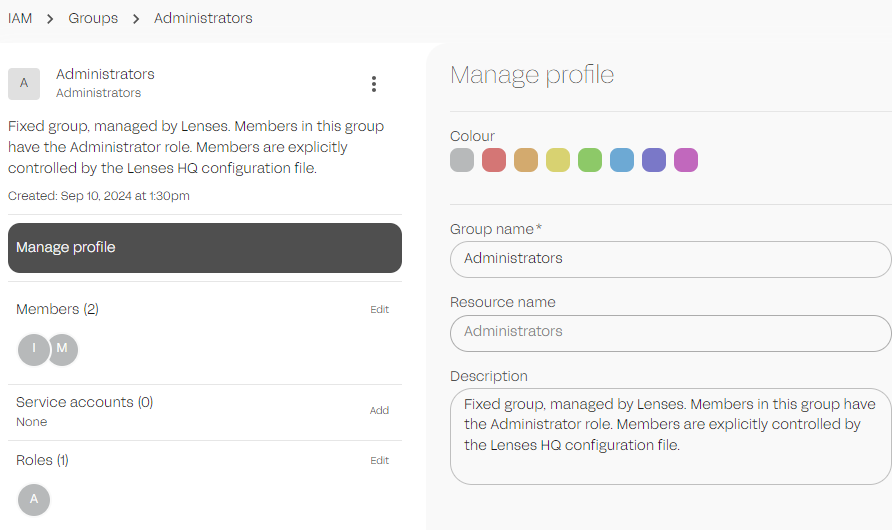
Groups can be defined with the following metadata:
1. Colour
2. Description
Each group has a resource that uniquely identifies it across an HQ installation.
## Create a Group
To create a group, go to **IAM → Groups → New Group**. Then assign members, service accounts, and roles.
IAM Groups
You can also manage groups via the CLI and YAML, for CI/CD automation.
{% code title="terminal" %}
```bash
➜ lenses groups
Manage Groups.
Usage:
lenses groups [command]
Aliases:
groups, grp
Available Commands:
create Creates a new Group.
delete Deletes a group.
get Gets a group by its name.
list Lists all groups
metadata Manages group metadata.
update Updates a group.
```
{% endcode %}
---
# Agent Instructions
This documentation is published with GitBook. GitBook is the documentation platform designed so that both humans and AI agents can read, navigate, and reason over technical content effectively. Learn more at gitbook.com.
## Querying This Documentation
If you need additional information that is not directly available in this page, you can query the documentation dynamically by asking a question.
Perform an HTTP GET request on the current page URL with the `ask` query parameter, and the optional `goal` query parameter:
```
GET https://docs.lenses.io/latest/devx/6.1/user-guide/iam/groups.md?ask=&goal=
```
`ask` is the immediate question: it should be specific, self-contained, and written in natural language.
`goal` is optional and describes the broader end goal you are ultimately trying to accomplish on behalf of the user. GitBook uses it to tailor the answer towards what is most useful for that goal.
The response will contain a direct answer to the question and relevant excerpts and sources from the documentation.
Use this mechanism when the answer is not explicitly present in the current page, you need clarification or additional context, or you want to retrieve related documentation sections.